
Live CE Webinar Open for Registration
Course Description
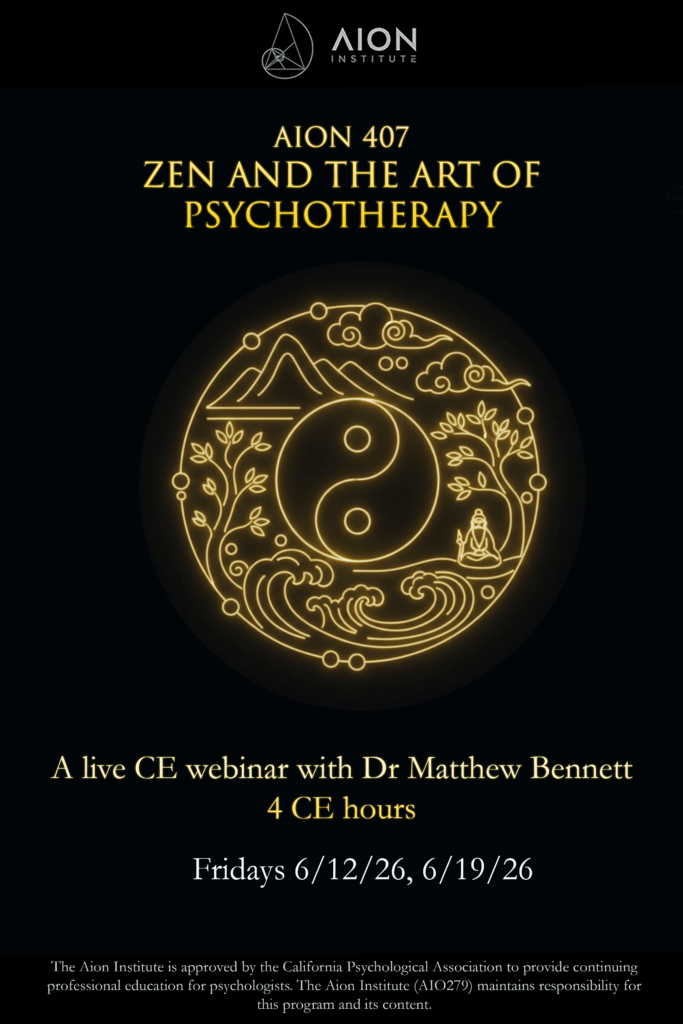
This course offers an immersion into the literary, philosophical, and contemplative streams of Zen, with a particular focus on the paradoxical discipline of Great Doubt and the experience of nonduality. A major theme will be Zen as illustrative of apophatic perspectives in psychotherapy. Through selected readings of Zen and pre-Zen writings—especially koans, haiku, and anecdotal encounters with Zen masters—participants will explore how language is used not to explain but to awaken, to fracture habitual patterns of thought, and to reveal the immediacy of being, while also exploring the parallels and implications for psychotherapeutic practice. Course emphasis will include amplification of Zen insights through a Western psychological lens, with attention to how Zen’s paradoxes mirror the psychoanalytic encounter with the unconscious and the unspoken.
Curricular Notes
AION 407 functions as a contemplative counterpoint within the 400-level curriculum, inviting clinicians to encounter an apophatic tradition that approaches psychological transformation through negation, paradox, and disciplined not-knowing. Zen’s refusal to explain becomes a mirror for the psychoanalytic encounter with what cannot yet be said, thought, or symbolized.
By engaging Zen texts alongside psychodynamic reflection, this course deepens clinicians’ capacity for presence, ethical restraint, and humility—returning advanced practitioners once more to philosophy, now embodied as practice rather than proposition.
register here
CE Value
This event spans 4 clock hours and awards 4 hours of Continuing Education.
Fees
$280 for CE credit
$190 for non CE / auditing
$150 for pre-licensed students
course status
This course is a live webinar. It counts as Elective credit towards any of Aion's certificate programs.
faculty
Prerequisites
None
Discord Link
If you’re curious about this course, or enrolled in it, please join our Discord Channel dedicated to it.
Event
details
Learning Objectives
- Explain the apophatic orientation shared by Zen and negative theology—where knowing proceeds through unknowing—and apply this perspective to psychotherapeutic work as a disciplined tolerance of absence, silence, and the limits of interpretation, rather than as a technique for development of insight.
- Analyze Zen literary forms (especially koans) as methods of psychological deconstruction, identifying parallels with psychoanalytic processes such as negative capability, reverie, and tolerance of the unformulated.
- Differentiate Zen-inspired nonconceptual awareness from dissociation, avoidance, or defensive withdrawal, enhancing clinicians’ capacity to work responsibly with contemplative language and experience in clinical settings.
- Apply insights from Zen practice to psychotherapeutic stance and technique—particularly presence, listening, and restraint—supporting a clinical posture that can hold ambiguity, silence, and not-knowing without premature interpretation.
References
Bion, W. (1970). Attention and interpretation. Tavistock.
Boshan (2016). Great doubt: Practicing Zen in the world (J. Shore, Trans.). Wisdom Books.
Henderson, D. (2014). Apophatic elements in the theory and practice of psychoanalysis: Pseudo-Dionysius and C. G. Jung (1st ed.). Routledge.
Hillman, J. (1975). Re-visioning psychology. Harper & Row.
Pickering, J. (2019). The search for meaning in psychotherapy: Spiritual practice, the apophatic way, and Bion. Routledge.
Reps, P., & Senzaki, N. (1957). Zen flesh, zen bones. Tuttle Publishing.
Suzuki, D. T. (1956). Zen Buddhism: Selected writings of D. T. Suzuki (W. Barrett, Ed.). Doubleday.
Target Audience
Aion Institute courses are open to all licensed mental health professionals, residents, interns, and graduate students in training, as well as members of the lay public who have an interest in psychodynamic psychology. Please use the following descriptions of our instructional level to gauge your own comfort level with the content.
✅ Introductory Level
For those beginning the path or seeking reorientation.
Courses at this level provide foundational knowledge in psychodynamic and integrative frameworks. No prior specialization is required—only a readiness to engage with depth-oriented psychological thought. These classes introduce core concepts, language, and philosophical underpinnings essential to the Aion curriculum.
Intermediate Level
For those building structure upon the foundation.
Intermediate courses deepen theoretical understanding and clinical application. Participants are expected to have prior exposure to psychoanalytic or Jungian concepts. These courses explore the evolution of major schools of thought, integrative approaches, and the emergence of relational and neurobiological paradigms, inviting greater complexity and case-based reflection.
Advanced Level
For those prepared to engage with nuance, synthesis, and transformation.
Advanced courses assume substantial familiarity with depth psychological theory and practice. Here, we move toward integrative models, complex case formulation, and contemporary theoretical frontiers. The focus is on synthesis, symbolic analysis, and the practitioner’s evolving stance as both healer and theoretician.
Hard Mode
For those willing to be changed.
Hard Mode courses are not merely advanced—they are initiatory. Designed for highly motivated participants, these offerings require deep reading, active participation, and a willingness to engage psychologically, imaginatively, and ethically. They are immersive, demanding, and transformational. These courses may involve longer sessions, seminar-style discussion, original writing or creative response, and the expectation that participants contribute to a shared field of inquiry. They are suited for those who seek to embody the work, not merely study it.
Cancellation Policy
The Aion Institute reserves the right to cancel or re-schedule any event, for which registrants will receive a full refund or credit. Refunds for payment processed online via electronic means will be refunded back to the credit card within 2 weeks after the cancellation.
Participants who wish to cancel their registration and paid registration fees online may be eligible for refund.
Participants may cancel their registration through the self-serve page accessed via the link included in the confirmation email sent after registration.
Please keep in mind that canceling a registration on the self-serve page does not automatically process a refund. Aion will refund cancellations made at least 24 hours prior to the start of this event.
Event accessibility
The Aion Institute is committed to providing an inclusive and accessible learning environment for all participants.
This event is conducted online using a virtual meeting platform (Zoom). We encourage all attendees to ensure that their technological setup—audio, video, internet connection, and device settings—meets their individual accessibility needs prior to the event.
If you require any additional support, accommodations, or accessibility considerations in order to participate fully, please don’t hesitate to contact us through one of the contact forms on this website. We will make every reasonable effort to ensure your learning experience is welcoming, respectful, and attuned to your needs.
Statement of Commercial Support
There is no commercial support for this Aion Institute program, nor are there any relationships between the CE Sponsor, presenting organization, presenter, program content, research, grants, or other funding that could reasonably be construed as conflicts of interest.
Continuing Education (CE) Provider Approvals
The Aion Institute is approved by the California Psychological Association to provide continuing professional education for psychologists. The Aion Institute (AIO279) maintains responsibility for this program and its content.