
Live CE Webinar Open for Registration
Course Description
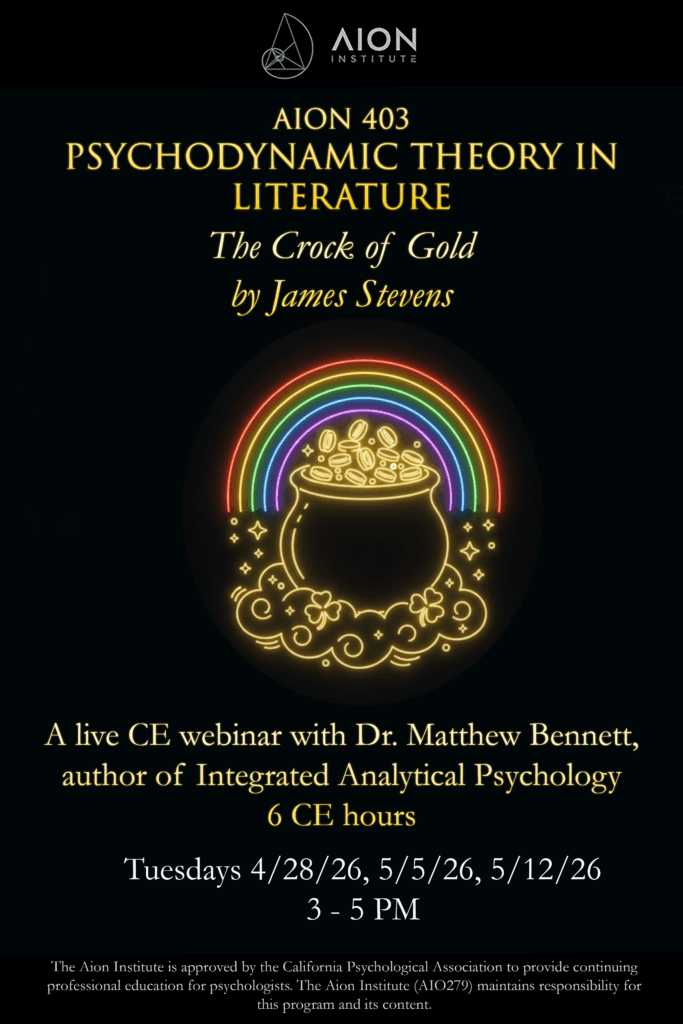
This installment of the Aion Literary Discussion Group is structured around The Crock of Gold by James Stephens, a mythopoetic novel that blends folklore, philosophical inquiry, humor, and psychological depth. The text offers a rich symbolic meditation on freedom and constraint, instinct and civilization, eros and law, and the tension between innocence and moral awakening—making it particularly resonant for advanced clinical reflection.
The seminar will proceed as a shared reading experience. Approximately half of each session will be devoted to close discussion of the assigned chapters, with attention to narrative structure, symbolic imagery, character dynamics, and philosophical themes. The remaining time will be devoted to didactic material selected by the instructor to amplify the psychological and clinical relevance of the text, drawing on psychodynamic, Jungian, and archetypal perspectives.
Curricular Notes
The content will be organized as follows:
Session 1 – Chapters 1–6: Orientation, Innocence, and the Mythic Field
Clinical–didactic emphasis
- Myth as psychological container
- Archetypal innocence and instinctual life
- The function of humor as defense and revelation
- Pre-reflective consciousness and psychic spontaneity
Session 2 – Chapters 7–12: Conflict, Law, and the Birth of Moral Consciousness
Clinical–didactic emphasis
- Superego formation and moral injury
- The transition from instinctual life to ethical self-awareness
- Shame, guilt, and conscience as developmental forces
- Cultural and symbolic prohibitions
Session 3 – Chapters 13–18: Integration, Paradox, and the Tragicomic Human Condition
Clinical–didactic emphasis
- Integration vs. solution
- Tragicomic consciousness (holding joy and sorrow together)
- Ethical maturity and psychological depth
- The therapist’s stance toward meaning, limitation, and grace
register here
CE Value
This event spans 6 clock hours and awards 6 hours of Continuing Education.
Fees
$420 for CE credit
$380 for non CE / auditing
$320 for pre-licensed students
course status
This course is a live webinar. It counts as Elective credit towards any of Aion's certificate programs.
faculty
Prerequisites
None
Discord Link
If you’re curious about this course, or enrolled in it, please join our Discord Channel dedicated to it.
Event
details
Learning Objectives
- Apply literary analysis of a mythopoetic text to clinical reflection, using The Crock of Gold to deepen understanding of unconscious process, ethical development, and therapeutic stance without collapsing symbolic meaning into diagnostic reduction.
- Session 1 – Myth, Innocence, and Instinct (Chapters 1–6): Identify how mythic imagery, humor, and archetypal figures in the early chapters of The Crock of Gold symbolize pre-reflective psychological life, instinctual vitality, and defenses against moral complexity, and relate these themes to early developmental states and clinical reverie.
- Session 2 – Law, Suffering, and Moral Awakening (Chapters 7–12): Analyze the emergence of law, punishment, and suffering in the narrative as symbolic representations of moral development, superego formation, and ethical conflict, and apply these themes to clinical formulations involving shame, guilt, conscience, and moral injury.
- Session 3 – Integration, Paradox, and Ethical Maturity (Chapters 13–18): Evaluate how the later chapters of The Crock of Gold portray psychological integration as the capacity to hold paradox rather than resolve it, and reflect on how this stance informs mature therapeutic presence, ethical humility, and tolerance of ambiguity in clinical practice.
References
Required Reading:
Stephens, J. (1912). The crock of gold. Macmillan.
Suggested Readings:
Hillman, J. (1975). Re-visioning psychology. Harper & Row.
Jung, C. G. (1968). The archetypes and the collective unconscious (R. F. C. Hull, Trans.; Vol. 9, Part 1). Princeton University Press. (Original work published 1934–1954)
Ogden, T. H. (2004). This art of psychoanalysis: Dreaming undreamt dreams and interrupted cries. Routledge.
Target Audience
Aion Institute courses are open to all licensed mental health professionals, residents, interns, and graduate students in training, as well as members of the lay public who have an interest in psychodynamic psychology. Please use the following descriptions of our instructional level to gauge your own comfort level with the content.
Cancellation Policy
The Aion Institute reserves the right to cancel or re-schedule any event, for which registrants will receive a full refund or credit. Refunds for payment processed online via electronic means will be refunded back to the credit card within 2 weeks after the cancellation.
Participants who wish to cancel their registration and paid registration fees online may be eligible for refund.
Participants may cancel their registration through the self-serve page accessed via the link included in the confirmation email sent after registration.
Please keep in mind that canceling a registration on the self-serve page does not automatically process a refund. Aion will refund cancellations made at least 24 hours prior to the start of this event.
Event accessibility
The Aion Institute is committed to providing an inclusive and accessible learning environment for all participants.
This event is conducted online using a virtual meeting platform (Zoom). We encourage all attendees to ensure that their technological setup—audio, video, internet connection, and device settings—meets their individual accessibility needs prior to the event.
If you require any additional support, accommodations, or accessibility considerations in order to participate fully, please don’t hesitate to contact us through one of the contact forms on this website. We will make every reasonable effort to ensure your learning experience is welcoming, respectful, and attuned to your needs.
Statement of Commercial Support
There is no commercial support for this Aion Institute program, nor are there any relationships between the CE Sponsor, presenting organization, presenter, program content, research, grants, or other funding that could reasonably be construed as conflicts of interest.
Continuing Education (CE) Provider Approvals
The Aion Institute is approved by the California Psychological Association to provide continuing professional education for psychologists. The Aion Institute (AIO279) maintains responsibility for this program and its content.