
Live CE Webinar Open for Registration
Course Description
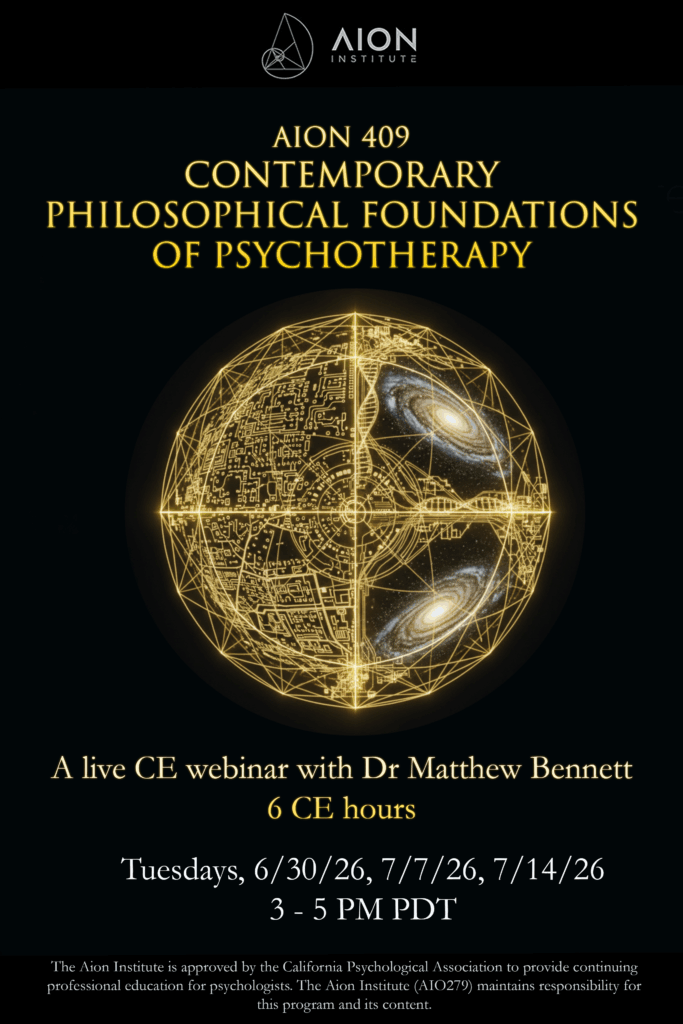
From Kant’s “veil of appearances” to Deleuze’s “infinite becoming,” this course traces the philosophical roots and modern continuations of constructivist and psychodynamic thought, exploring how foundational ideas shape contemporary clinical theory. We will examine Constructivism and German Idealism, with particular focus on Kant’s critical philosophy and its deep influence on Jung’s psychological framework—especially Jung’s notions of archetype, the limits of knowledge, and the structuring role of the psyche. The seminar will also engage with contemporary Continental perspectives, particularly the provocative insights of Slavoj Žižek and Gilles Deleuze, whose work challenges linear, structuralist thinking and reimagines desire, subjectivity, and reality in dynamic, nondual terms. Participants will gain a conceptual bridge between classical philosophical roots and postmodern frameworks, considering how these paradigms inform depth psychological practice and the ethics of therapeutic engagement.
Curricular Notes
AION 409 functions as a philosophical keystone within the 400-level curriculum, explicitly linking depth psychology to its modern philosophical inheritance. Where earlier seminars engage mysticism, language, and liberation as lived encounters, this course clarifies the epistemological stakes underlying all clinical work: what can be known, how meaning is constituted, and where interpretation must yield to ethical restraint. By placing Kant, Jung, and contemporary Continental thinkers into dialogue, the course equips clinicians to recognize that therapeutic engagement is never philosophically neutral. In doing so, AION 409 returns participants to philosophy as the quiet architecture shaping every clinical act.
register here
CE Value
This event spans 6 clock hours and awards 6 hours of Continuing Education.
Fees
$420 for CE credit
$380 for non CE / auditing
$320 for pre-licensed students
course status
This course is a live webinar. It counts as Elective credit towards any of Aion's certificate programs.
faculty
Prerequisites
None
Discord Link
If you’re curious about this course, or enrolled in it, please join our Discord Channel dedicated to it.
Event
details
Learning Objectives
- Describe core principles of constructivist and post-Kantian philosophy—including the limits of knowledge, mediation of experience, and the structuring role of the subject—and explain their relevance to depth psychological theory and clinical formulation.
- Analyze the influence of Kant’s critical philosophy on Jung’s psychological framework, particularly in relation to archetypes, symbolic mediation, and the ethical implications of epistemic humility in clinical work.
- Differentiate structural and constructivist models of psyche from contemporary Continental approaches emphasizing becoming, multiplicity, and desire, thereby expanding clinicians’ conceptual repertoire for understanding subjectivity and change.
- Apply philosophical insights from contemporary thinkers to psychotherapeutic practice, especially regarding interpretation, ethical restraint, and the clinician’s responsibility when working with ambiguity, difference, and non-linear transformation.
References
Deleuze, G. (1994). Difference and repetition (P. Patton, Trans.). Columbia University Press. (Original work published 1968)
Deleuze, G., & Guattari, F. (1983). Anti-Oedipus: Capitalism and schizophrenia (R. Hurley, M. Seem, & H. R. Lane, Trans.). University of Minnesota Press. (Original work published 1972)
Jung, C.G. (1968). The archetypes and the collective unconscious (R. F. C. Hull, Trans.; Vol. 9, Part 1). Princeton University Press. (Original work published 1934–1954)
Kant, I. (1998). Critique of pure reason (P. Guyer & A. W. Wood, Trans.). Cambridge University Press. (Original work published 1781)
Nietzsche, F. (2008). The birth of tragedy. Oxford University Press.
Ogden, T. (1997). Reverie and interpretation: Sensing something human. Jason Aronson.
Sartre, J. P. (2003). Being and nothingness (H. E. Barnes, Trans.; 2nd ed.). Routledge.
Žižek, S. (2006). The parallax view. MIT Press.
Target Audience
Aion Institute courses are open to all licensed mental health professionals, residents, interns, and graduate students in training, as well as members of the lay public who have an interest in psychodynamic psychology. Please use the following descriptions of our instructional level to gauge your own comfort level with the content.
Cancellation Policy
The Aion Institute reserves the right to cancel or re-schedule any event, for which registrants will receive a full refund or credit. Refunds for payment processed online via electronic means will be refunded back to the credit card within 2 weeks after the cancellation.
Participants who wish to cancel their registration and paid registration fees online may be eligible for refund.
Participants may cancel their registration through the self-serve page accessed via the link included in the confirmation email sent after registration.
Please keep in mind that canceling a registration on the self-serve page does not automatically process a refund. Aion will refund cancellations made at least 24 hours prior to the start of this event.
Event accessibility
The Aion Institute is committed to providing an inclusive and accessible learning environment for all participants.
This event is conducted online using a virtual meeting platform (Zoom). We encourage all attendees to ensure that their technological setup—audio, video, internet connection, and device settings—meets their individual accessibility needs prior to the event.
If you require any additional support, accommodations, or accessibility considerations in order to participate fully, please don’t hesitate to contact us through one of the contact forms on this website. We will make every reasonable effort to ensure your learning experience is welcoming, respectful, and attuned to your needs.
Statement of Commercial Support
There is no commercial support for this Aion Institute program, nor are there any relationships between the CE Sponsor, presenting organization, presenter, program content, research, grants, or other funding that could reasonably be construed as conflicts of interest.
Continuing Education (CE) Provider Approvals
The Aion Institute is approved by the California Psychological Association to provide continuing professional education for psychologists. The Aion Institute (AIO279) maintains responsibility for this program and its content.