
Live CE Webinar Open for Registration
Course Description
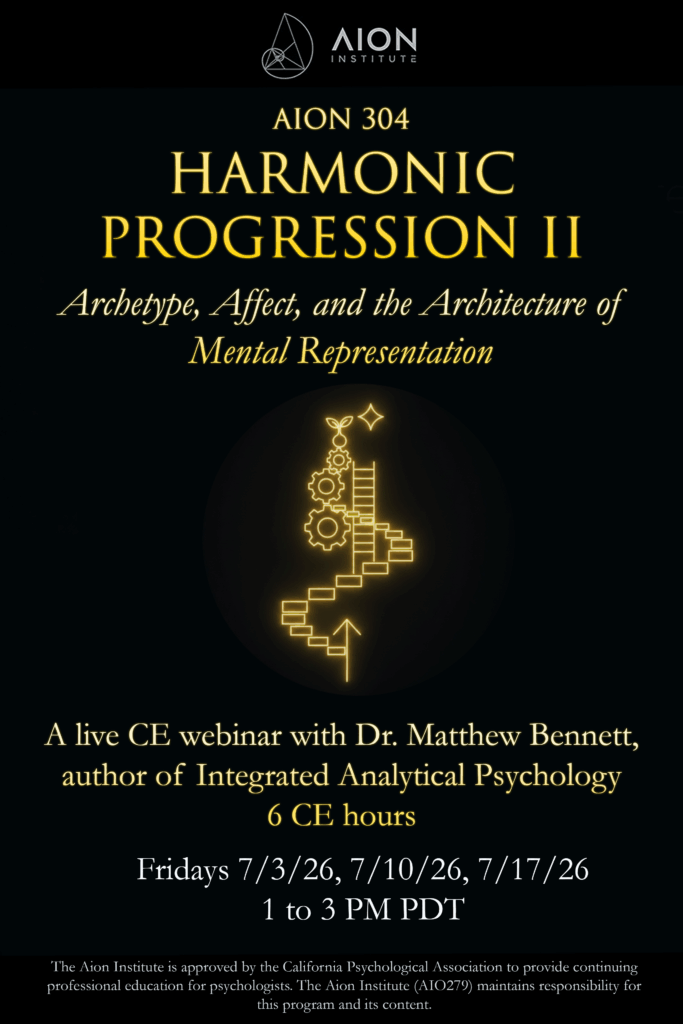
This seminar offers an in-depth exploration of the harmonic levels of mental representation as described in Matthew Bennett’s Integrated Analytical Model. Participants will examine the developmental continuum that spans from archetypal probability fields to the fully realized self, engaging with key psychoanalytic and Jungian perspectives alongside complexity theory and contemporary neuroscience. Special attention will be given to the concepts of harmonic vectors, affect as a motivator of psychological development, and the interplay of defenses and discontinuities within this holarchic system. Through lecture, discussion, and clinical illustration, attendees will gain tools for understanding how these nested harmonics shape personality, attachment, and therapeutic transformation.
Curricular Notes
Internal architecture and affective dynamics
AION 304 deepens the Harmonic Progression by moving from formal systems dynamics (AION 303) into the internal architecture of meaning and affect. Where AION 303 establishes nonlinearity, emergence, and adaptive reorganization as governing principles of mind, AION 304 articulates what is reorganizing: archetypal potentials, affective forces, defenses, and representational structures. Together, these courses provide clinicians with a meta-developmental map for understanding personality, attachment, and transformation as nested, affect-driven processes, setting the stage for advanced work in ethics, character, and integrative clinical practice.register here
CE Value
This event spans 6 clock hours and awards 6 hours of Continuing Education.
Fees
$420 for CE credit
$380 for non CE / auditing
$320 for pre-licensed students
course status
This course is a live webinar. It contributes to the Certificate in Integrated Analytical Psychology.
faculty
Prerequisites
AION 303
Discord Link
If you’re curious about this course, or enrolled in it, please join our Discord Channel dedicated to it.
Event
details
Learning Objectives
- Describe core principles of chaos theory and complex adaptive systems—including nonlinearity, emergence, attractors, and phase transitions—and explain how these principles offer an alternative framework for understanding mental representation and consciousness.
- Analyze psychological development and psychopathology as emergent responses to symmetry-breaking events (e.g., trauma, loss, developmental disruption), enabling clinicians to conceptualize symptoms as adaptive attempts at coherence rather than isolated deficits or dysfunctions.
- Differentiate traditional linear models of mind (e.g., classical psychoanalytic and cognitive-behavioral formulations) from nonlinear, emergentist perspectives, and evaluate the clinical implications of each for formulation, prognosis, and therapeutic change.
- Apply concepts from deterministic chaos, the Bayesian Brain hypothesis, and free-energy minimization to clinical material in order to formulate treatment as an iterative process of revising internal models, tolerating uncertainty, and supporting adaptive reorganization of meaning and self-experience.
References
Bennett, M. (2024). Towards an integrated analytical psychology: Return to freedom and dignity. Routledge.
Clark, A. (2016). Surfing uncertainty: Prediction, action, and the embodied mind. Oxford University Press.
Friston, K. (2010). The free-energy principle: A unified brain theory? Nature Reviews Neuroscience, 11(2), 127–138. https://doi.org/10.1038/nrn2787
Hipólito, I., & Kirchhoff, M. (2023). Breaking boundaries: The Bayesian brain hypothesis for perception and prediction. Consciousness and Cognition, 111: 1–8.Kauffman, S. A. (1995). At home in the universe: The search for laws of self-organization and complexity. Oxford University Press.
Kohonen, T., (2013). Essentials of the self‑organizing map. Neural Networks, 37: 52–65.
Panksepp, J. (1998). Affective neuroscience: The foundations of human and animal emotions. Oxford University Press.
Scott, A. C. (2007). The nonlinear universe: Chaos, emergence, life. Springer.
Solms, M. (2021). The hidden spring: A journey to the source of consciousness. W. W. Norton & Company.
Thelen, E., & Smith, L. B. (1994). A dynamic systems approach to the development of cognition and action. MIT Press.
Target Audience
Aion Institute courses are open to all licensed mental health professionals, residents, interns, and graduate students in training, as well as members of the lay public who have an interest in psychodynamic psychology. Please use the following descriptions of our instructional level to gauge your own comfort level with the content.
Cancellation Policy
The Aion Institute reserves the right to cancel or re-schedule any event, for which registrants will receive a full refund or credit. Refunds for payment processed online via electronic means will be refunded back to the credit card within 2 weeks after the cancellation.
Participants who wish to cancel their registration and paid registration fees online may be eligible for refund.
Participants may cancel their registration through the self-serve page accessed via the link included in the confirmation email sent after registration.
Please keep in mind that canceling a registration on the self-serve page does not automatically process a refund. Aion will refund cancellations made at least 24 hours prior to the start of this event.
Event accessibility
The Aion Institute is committed to providing an inclusive and accessible learning environment for all participants.
This event is conducted online using a virtual meeting platform (Zoom). We encourage all attendees to ensure that their technological setup—audio, video, internet connection, and device settings—meets their individual accessibility needs prior to the event.
If you require any additional support, accommodations, or accessibility considerations in order to participate fully, please don’t hesitate to contact us through one of the contact forms on this website. We will make every reasonable effort to ensure your learning experience is welcoming, respectful, and attuned to your needs.
Statement of Commercial Support
There is no commercial support for this Aion Institute program, nor are there any relationships between the CE Sponsor, presenting organization, presenter, program content, research, grants, or other funding that could reasonably be construed as conflicts of interest.
Continuing Education (CE) Provider Approvals
The Aion Institute is approved by the California Psychological Association to provide continuing professional education for psychologists. The Aion Institute (AIO279) maintains responsibility for this program and its content.