
Live CE Webinar Open for Registration
Course Description
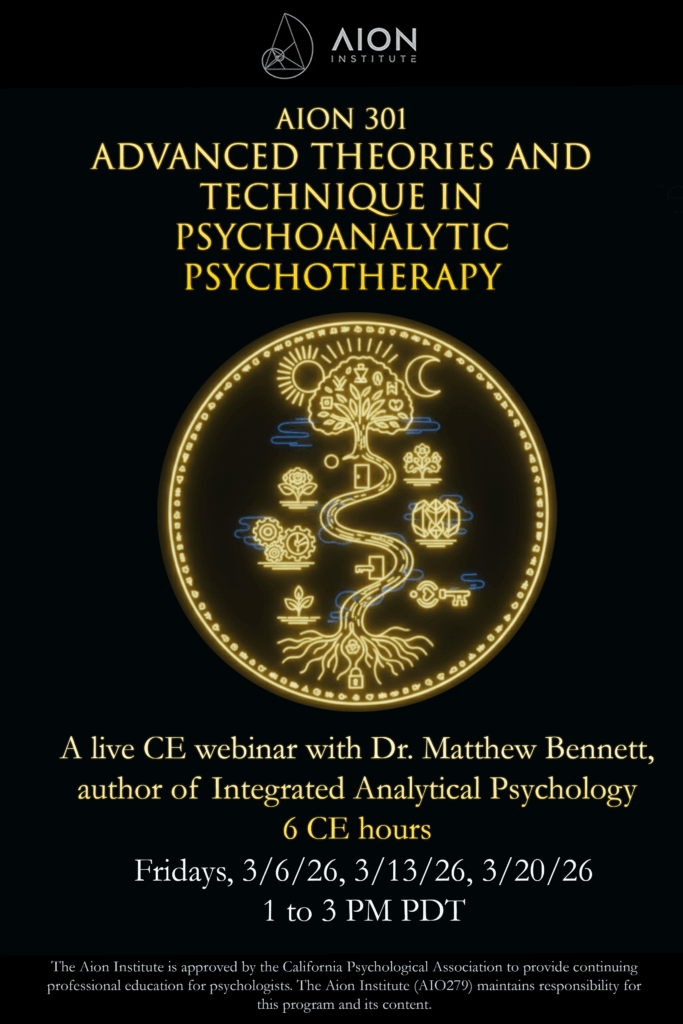
This advanced course expands upon the foundational psychoanalytic perspectives introduced in AION 201 and 203, offering a deeper engagement with contemporary psychoanalytic theory and practice. Topics include the intersubjective turn in psychoanalysis as articulated by Robert Stolorow, Philip Bromberg, and Jessica Benjamin; the intersections between modern psychoanalysis and current research on the neurobiology of attachment; and an accessible introduction to key concepts in Lacanian theory. Through lectures, case discussions, and comparative analysis, participants will strengthen their conceptual framework for working with complex relational dynamics and unconscious processes in clinical settings.
Curricular Notes
Intersubjective and relational consolidation
AION 301 marks a decisive shift from structural and developmental psychoanalysis into explicitly relational and intersubjective thinking. By engaging the work of Stolorow, Bromberg, and Benjamin, the course reframes therapeutic action as a co-constructed process shaped by mutual influence, dissociation, rupture, and recognition. The introduction of Lacanian concepts serves as a disciplined encounter with language, subjectivity, and desire—challenging clinicians to refine how they listen, interpret, and locate meaning within the analytic field. This course matures the clinician’s capacity to tolerate ambiguity, mutuality, and ethical responsibility within the therapeutic relationship, preparing them for work with complex relational dynamics and unconscious enactment.
register here
CE Value
This event spans 6 clock hours and awards 6 hours of Continuing Education.
Fees
$420 for CE credit
$380 for non CE / auditing
$320 for pre-licensed students
course status
This course is a live webinar. It contributes to the Certificate in Integrated Analytical Psychology.
faculty
Prerequisites
None
Discord Link
If you’re curious about this course, or enrolled in it, please join our Discord Channel dedicated to it.
Event
details
Learning Objectives
- Describe the intersubjective turn in contemporary psychoanalysis, as articulated by Robert Stolorow, Philip Bromberg, and Jessica Benjamin, and explain how this shift reconceptualizes therapeutic action as co-created within the analytic relationship.
- Analyze complex relational dynamics in treatment—including enactment, dissociation, rupture, and recognition—using intersubjective and relational psychoanalytic frameworks to refine moment-to-moment clinical responsiveness.
- Differentiate contemporary psychoanalytic perspectives from classical drive- and ego-psychological models by articulating how modern theories integrate attachment research and affective neuroscience into psychodynamic formulation.
- Apply advanced psychoanalytic concepts—including key Lacanian ideas (e.g., subjectivity, desire, symbolic mediation)—to enhance clinical understanding of unconscious process, language, and relational impasse, without relying on technical jargon or abstraction.
References
Benjamin, J. (1995). Like subjects, love objects: Essays on recognition and sexual difference. Yale University Press.
Bromberg, P. M. (1998). Standing in the spaces: Essays on clinical process, trauma, and dissociation. The Analytic Press.
Davies, J. M. (1996). Linking the pre‑analytic with the postclassical: Integration, dissociation, and the multiplicity of unconscious process. Contemporary Psychoanalysis, 32: 553–575.
Felman, S. (1989). Jacques Lacan and the adventure of insight: Psychoanalysis in contemporary culture. Harvard University Press.
Grotstein, J. S. (2004). The seventh servant: The implications of a truth drive in Bion’s theory of ‘O’. International Journal of Psycho‑Analysis, 85(5): 1081–1101.
Schore, A. N. (2003). Affect dysregulation and disorders of the self. W. W. Norton & Company.
Harris, A. (1996). The conceptual power of multiplicity. Contemporary Psychoanalysis, 32: 537–552.
Howell, E. (2022). Philip Bromberg and the revolution about dissociated self‑States. Contemporary Psychoanalysis, 58(2): 299–309.
Ogden, T. H. (1989). On the concept of an autistic‑contiguous position. International Journal of Psychoanalysis, 70(1): 127–140.
Ogden, T. H. (1989). The primitive edge of experience. Jason Aronson.
Stolorow, R. D., Atwood, G. E., & Orange, D. M. (2002). Worlds of experience: Interweaving philosophical and clinical dimensions in psychoanalysis. Basic Books.
Lacan, J. (2006). Écrits (B. Fink, Trans.). W. W. Norton & Company. (Original work published 1966)
Stolorow, R. D., Brandchaft, B., & Atwood, G. E. (1987). Psychoanalytic treatment: An intersubjective approach. Analytic Press.
Target Audience
Aion Institute courses are open to all licensed mental health professionals, residents, interns, and graduate students in training, as well as members of the lay public who have an interest in psychodynamic psychology. Please use the following descriptions of our instructional level to gauge your own comfort level with the content.
Cancellation Policy
The Aion Institute reserves the right to cancel or re-schedule any event, for which registrants will receive a full refund or credit. Refunds for payment processed online via electronic means will be refunded back to the credit card within 2 weeks after the cancellation.
Participants who wish to cancel their registration and paid registration fees online may be eligible for refund.
Participants may cancel their registration through the self-serve page accessed via the link included in the confirmation email sent after registration.
Please keep in mind that canceling a registration on the self-serve page does not automatically process a refund. Aion will refund cancellations made at least 24 hours prior to the start of this event.
Event accessibility
The Aion Institute is committed to providing an inclusive and accessible learning environment for all participants.
This event is conducted online using a virtual meeting platform (Zoom). We encourage all attendees to ensure that their technological setup—audio, video, internet connection, and device settings—meets their individual accessibility needs prior to the event.
If you require any additional support, accommodations, or accessibility considerations in order to participate fully, please don’t hesitate to contact us through one of the contact forms on this website. We will make every reasonable effort to ensure your learning experience is welcoming, respectful, and attuned to your needs.
Statement of Commercial Support
There is no commercial support for this Aion Institute program, nor are there any relationships between the CE Sponsor, presenting organization, presenter, program content, research, grants, or other funding that could reasonably be construed as conflicts of interest.
Continuing Education (CE) Provider Approvals
The Aion Institute is approved by the California Psychological Association to provide continuing professional education for psychologists. The Aion Institute (AIO279) maintains responsibility for this program and its content.