
Live CE Webinar Open for Registration
Course Description
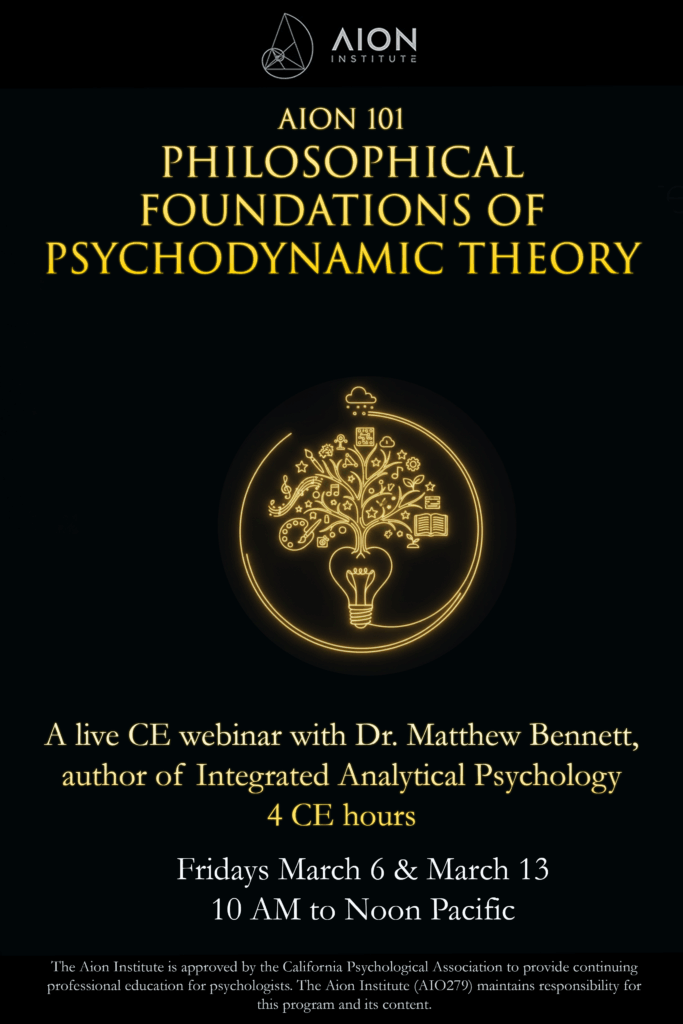
This class includes two two-hour sessions incorporating an overview of some of the more important philosophical, cultural, and scientific contexts leading the development of psychodynamic psychology. Content will include a review of the following philosophical and cultural foundations: ancient systems of spirituality, classical Greek philosophical models such as stoicism, skepticism, and hedonism, as well as neo-platonism, Gnosticism, empiricism, humanism, phenomenology, critical theory, and Zen Buddhism.Curricular Notes
Ontological and epistemological grounding
AION 101 establishes the philosophical soil from which psychodynamic theory grows. Rather than treating psychotherapy as a technical discipline detached from its intellectual roots, this course makes explicit the metaphysical, ethical, and cultural assumptions embedded in all clinical work. By surveying traditions ranging from Greek philosophy and empiricism to phenomenology, critical theory, and Zen Buddhism, the course destabilizes premature theoretical certainty and cultivates reflective awareness of worldview. Developmentally, this course moves participants from unexamined clinical inheritance to self-aware theoretical orientation. It prepares clinicians to recognize that every intervention implies a philosophy of mind, suffering, and change.
register here
CE Value
This event spans 4 clock hours and awards 4 hours of Continuing Education.
Fees
$280 for CE credit
$190 for non CE / auditing
$150 for pre-licensed students
course status
This course is a live webinar. It contributes to the Psychodynamic Respecialization Certificate.
faculty
Prerequisites
None
Discord Link
If you’re curious about this course, or enrolled in it, please join our Discord Channel dedicated to it.
Event
details
Learning Objectives
- Describe major philosophical and cultural traditions—including ancient spiritual systems, classical Greek philosophy, empiricism, phenomenology, critical theory, and Zen—and explain how these traditions shaped foundational assumptions about mind, self, suffering, and change within psychodynamic psychology.
- Differentiate contrasting philosophical orientations to human experience (e.g., rationalist, phenomenological, spiritual, and critical perspectives) and identify how these differences implicitly inform clinical stance, therapeutic authority, and models of psychological change.
- Apply philosophical reflection to clinical practice by articulating a more coherent and self-aware theoretical orientation, supporting greater intentionality, flexibility, and ethical clarity in psychodynamic work with diverse patients.
References
Ellenberger, H. F. (1970). The discovery of the unconscious: The history and evolution of dynamic psychiatry. Basic Books.
Freud, S. (1961). The ego and the id (J. Strachey, Trans.). W. W. Norton. (Original work published 1923)
Jung, C. G. (1968). The structure and dynamics of the psyche (R. F. C. Hull, Trans.; Vol. 8). Princeton University Press.
Merleau-Ponty, M. (2012). Phenomenology of perception (D. A. Landes, Trans.). Routledge. (Original work published 1945)
Safran, J. D., & Messer, S. B. (1997). Psychotherapy integration: A postmodern critique. Clinical Psychology: Science and Practice, 4(2), 140–152.
https://doi.org/10.1111/j.1468-2850.1997.tb00106.x
Zen Flesh, Zen Bones (1957). Zen flesh, Zen bones: A collection of Zen and pre-Zen writings. Tuttle Publishing.
Target Audience
Aion Institute courses are open to all licensed mental health professionals, residents, interns, and graduate students in training, as well as members of the lay public who have an interest in psychodynamic psychology. Please use the following descriptions of our instructional level to gauge your own comfort level with the content.
Cancellation Policy
The Aion Institute reserves the right to cancel or re-schedule any event, for which registrants will receive a full refund or credit. Refunds for payment processed online via electronic means will be refunded back to the credit card within 2 weeks after the cancellation.
Participants who wish to cancel their registration and paid registration fees online may be eligible for refund.
Participants may cancel their registration through the self-serve page accessed via the link included in the confirmation email sent after registration.
Please keep in mind that canceling a registration on the self-serve page does not automatically process a refund. Aion will refund cancellations made at least 24 hours prior to the start of this event.
Event accessibility
The Aion Institute is committed to providing an inclusive and accessible learning environment for all participants.
This event is conducted online using a virtual meeting platform (Zoom). We encourage all attendees to ensure that their technological setup—audio, video, internet connection, and device settings—meets their individual accessibility needs prior to the event.
If you require any additional support, accommodations, or accessibility considerations in order to participate fully, please don’t hesitate to contact us through one of the contact forms on this website. We will make every reasonable effort to ensure your learning experience is welcoming, respectful, and attuned to your needs.
Statement of Commercial Support
There is no commercial support for this Aion Institute program, nor are there any relationships between the CE Sponsor, presenting organization, presenter, program content, research, grants, or other funding that could reasonably be construed as conflicts of interest.
Continuing Education (CE) Provider Approvals
The Aion Institute is approved by the California Psychological Association to provide continuing professional education for psychologists. The Aion Institute (AIO279) maintains responsibility for this program and its content.