AION 415 Course Evaluation
Course Description
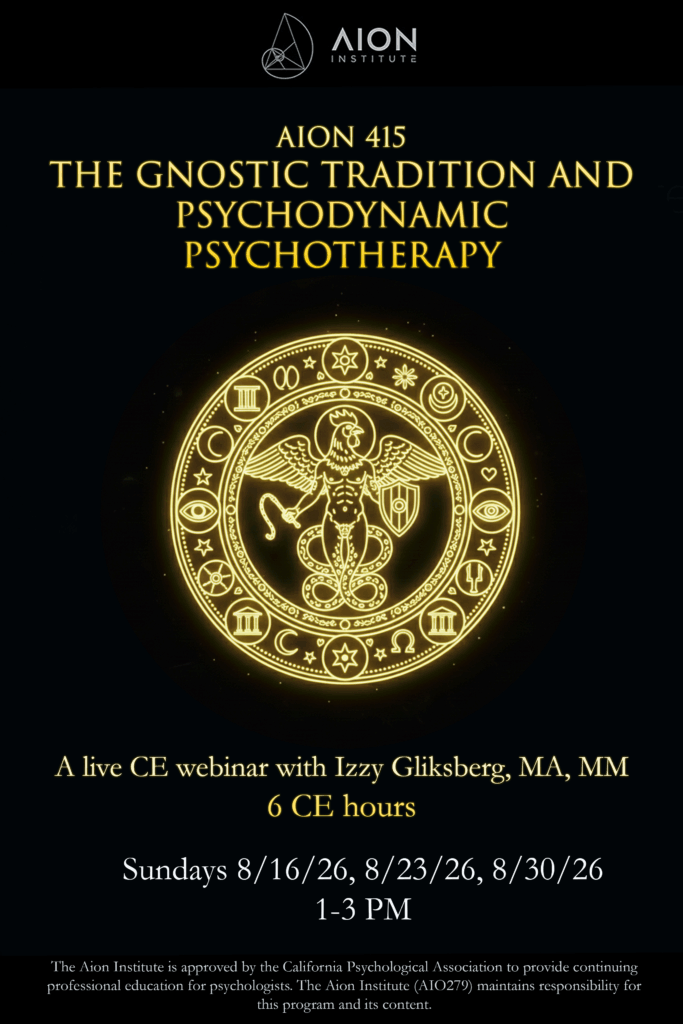
This course explores Gnosticism and its relevance to depth-oriented and psychodynamic clinical practice. Gnosticism was not only an early, unorthodox expression of Christianity, but—according to Carl Jung—it projected an intricate theology that provides us a psychological blueprint of the Western psyche as it emerged from the ancient world and gradually took the form of modern culture. From this perspective, engaging with Gnostic material becomes a necessary step in deciphering the unconscious conflicts and forms of psychological suffering that continue to trouble the modern Western psyche. Key themes include Gnostic creation myths, the archetype of Sophia, and Jung’s sustained engagement with Gnostic symbolism and cosmology. Emphasis will be placed on amplifying Gnostic thought through a Western psychological lens, highlighting its relevance for contemporary psychodynamic therapeutic work. Clinical implications for assessment and case formulation will be explored throughout. The material is presented conceptually rather than religiously, and no prior knowledge of Gnosticism is required.
Curricular Notes
AION 416 serves the curriculum by introducing alienation, fracture, and conflict-with-the-world as foundational psychological conditions rather than pathologies to be resolved prematurely. Within the AION architecture, this course provides a symbolic framework for understanding why psyche experiences the world as fallen, distorted, or hostile—and why suffering often presents as a problem of meaning rather than adaptation. Its function is not to teach Gnosticism as belief, but to restore conflictual cosmology as a legitimate psychological orientation. By doing so, the course legitimizes experiences of estrangement, mistrust of surface reality, and longing for hidden knowledge as structurally meaningful dimensions of the Western psyche—especially relevant in clinical work with depression, despair, nihilism, and moral injury.
At the advanced stage of training, clinicians must be able to tolerate world-negating experiences without correcting, normalizing, or dissolving them too quickly. AION 416 supports this maturity by offering a symbolic language in which alienation and protest are intelligible, purposeful, and psychologically generative rather than merely regressive or defensive.