
AION 414 Course Evaluation
Course Description
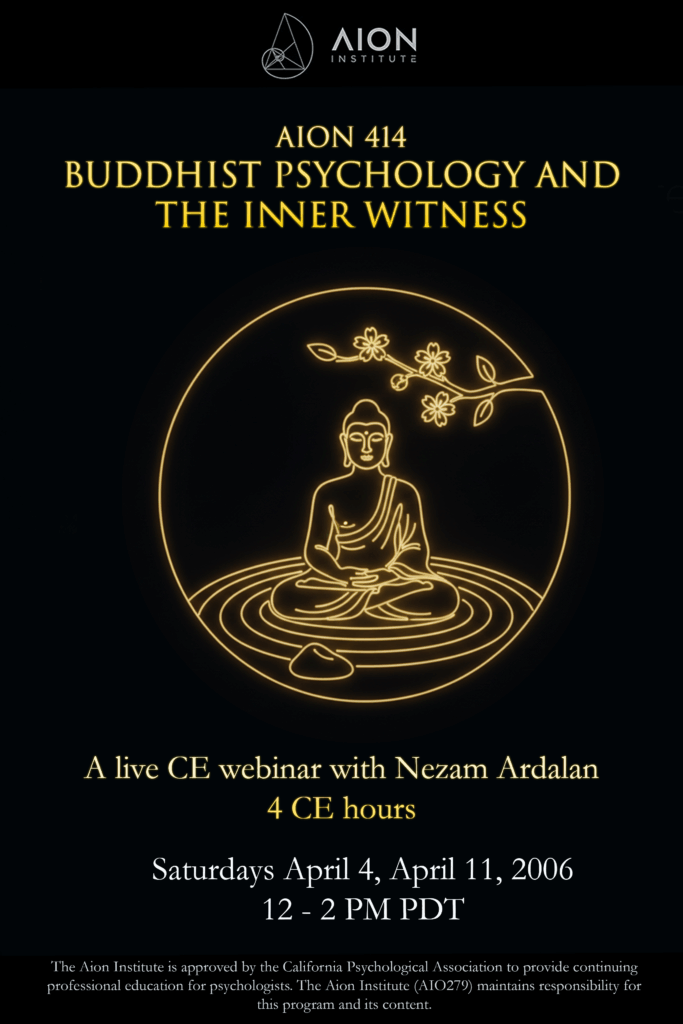
This seminar will focus on the skill and use of cultivating and strengthening the capacity to observe one’s inner process in psychotherapeutic work. It will focus on Buddhist Psychological roots of this process, while also covering Psychoanalytic, Jungian, and Somatic Psychotherapy (Hakomi) theories. A basic understanding of the principles of Buddhist Psychology will be discussed. The importance and function of the inner witness will be traced through the three main schools of Buddhism- Hinayana, Mahayana, and Vajrayana- with a specific focus on the Mahayana concept of Bodhicitta. The clinical benefit of building a strong inner witness will be discussed, specifically as it relates to transference, countertransference, affect tolerance, mirroring, empathetic listening, the transcendent function, memory reconsolidation, and the creation of new neural pathways.
Curricular Notes
AION 414 serves the curriculum by strengthening the clinician’s capacity for internal observation as a stable psychological function. Within the AION architecture—where participants have already encountered depth, symbolism, desire, ethics, and cultural critique—this course provides a disciplining counterweight: the cultivation of a witnessing position that can remain present without collapse, fusion, or enactment. Its role is not to introduce mindfulness as technique, nor Buddhism as belief system, but to anchor reflective consciousness itself as a prerequisite for advanced clinical work. The course ensures that increasing symbolic and ethical complexity does not overwhelm the clinician’s capacity to observe, metabolize, and remain relationally available.