
AION 304 Course Evaluation
Course Description
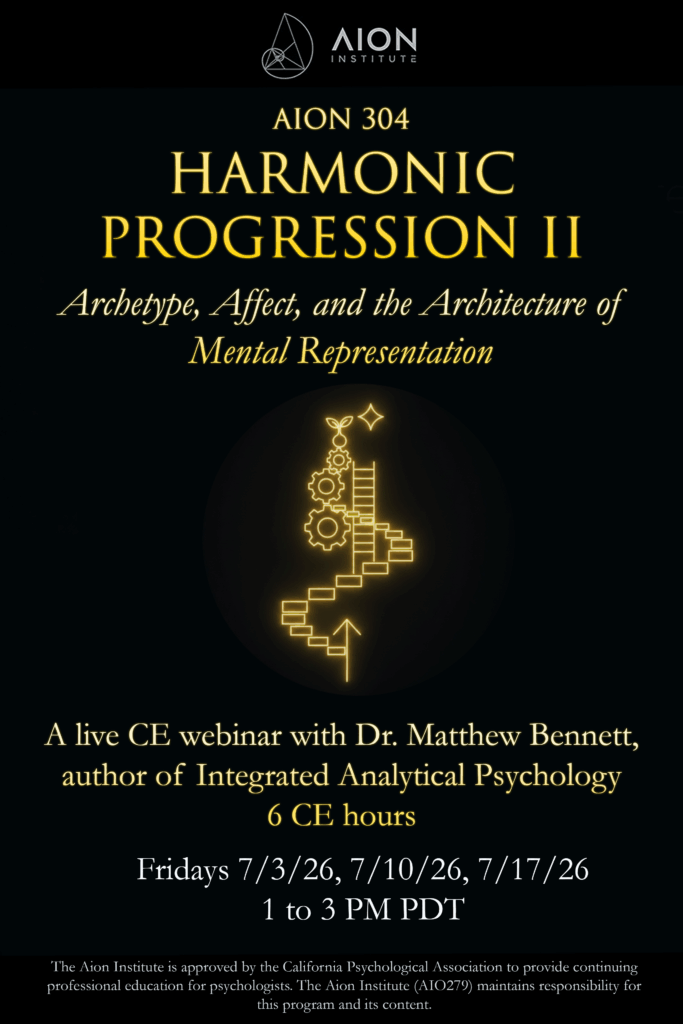
This seminar offers an in-depth exploration of the harmonic levels of mental representation as described in Matthew Bennett’s Integrated Analytical Model. Participants will examine the developmental continuum that spans from archetypal probability fields to the fully realized self, engaging with key psychoanalytic and Jungian perspectives alongside complexity theory and contemporary neuroscience. Special attention will be given to the concepts of harmonic vectors, affect as a motivator of psychological development, and the interplay of defenses and discontinuities within this holarchic system. Through lecture, discussion, and clinical illustration, attendees will gain tools for understanding how these nested harmonics shape personality, attachment, and therapeutic transformation.
Curricular Notes
Internal architecture and affective dynamics
AION 304 deepens the Harmonic Progression by moving from formal systems dynamics (AION 303) into the internal architecture of meaning and affect. Where AION 303 establishes nonlinearity, emergence, and adaptive reorganization as governing principles of mind, AION 304 articulates what is reorganizing: archetypal potentials, affective forces, defenses, and representational structures. Together, these courses provide clinicians with a meta-developmental map for understanding personality, attachment, and transformation as nested, affect-driven processes, setting the stage for advanced work in ethics, character, and integrative clinical practice.
Open Evaluation
The Aion Institute is approved by the California Psychological Association to provide continuing professional education for psychologists. The Aion Institute (AIO279) maintains responsibility for this program and its content.