
AION 203 Course Evaluation
Course Description
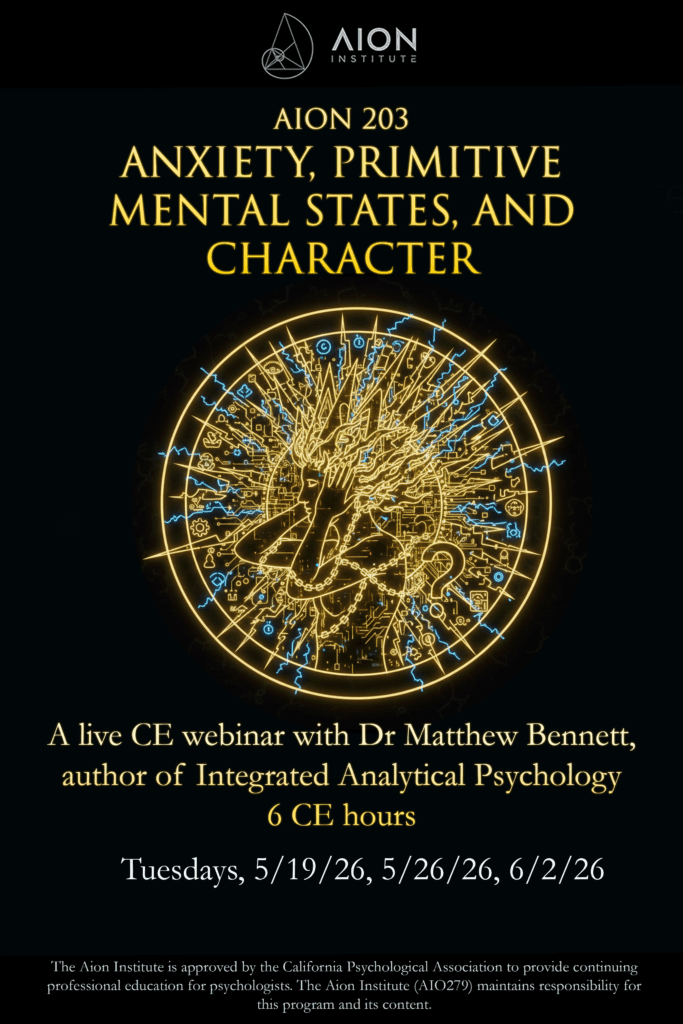
This course approaches personality development as an epiphenomenon of attachment experience and temperament, and specifically focuses on the role of primitive mental states in attachment formation. Course content will focus on the developmental scaffolding of anxiety states and their complex relationships with attachment styles, and how these attachment styles inform the development of adult personality. The theoretical context for this course will include object relations, self psychology, and Jungian perspectives.
Curricular Notes
Developmental synthesis and affective organization
AION 203 serves as the conceptual hinge of the intermediate sequence. Drawing on object relations, self psychology, attachment theory, and Jungian perspectives, the course frames personality development as an epiphenomenon of how primitive mental states and anxiety are regulated within early attachment contexts. Rather than treating anxiety as a surface symptom, the course positions it as the organizing pressure around which character, defenses, and relational expectations crystallize. This course enables clinicians to read anxiety structurally, as a signal of developmental organization: thereby sharpening formulation, pacing, and relational attunement.