
AION 306 Evaluation
Course Description
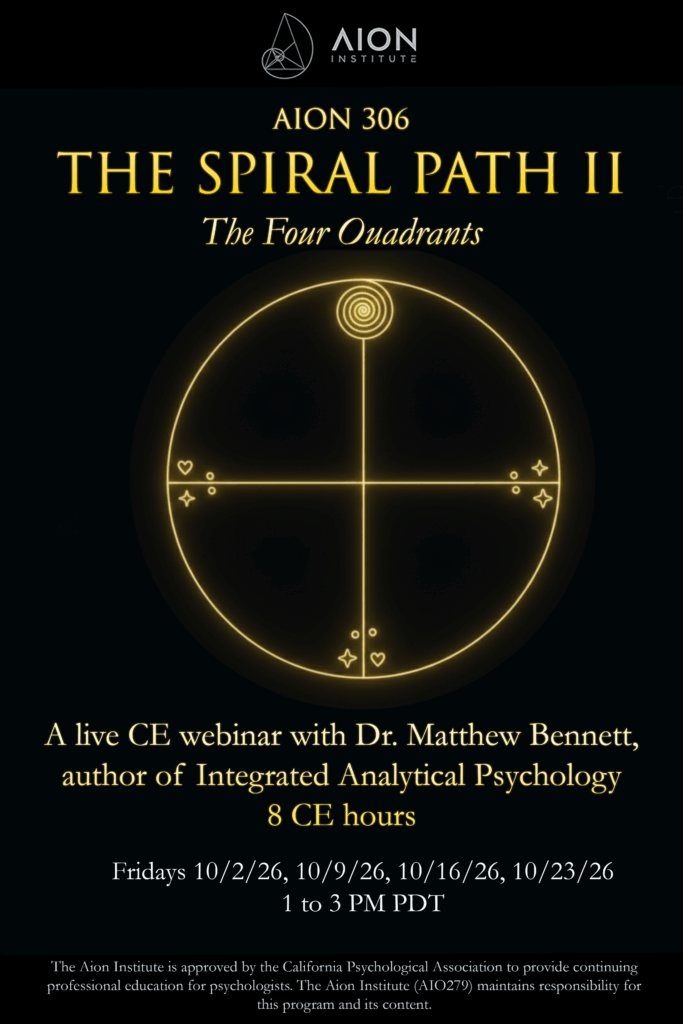
This seminar explores the full spectrum of Matthew Bennett’s Four Quadrants Model, charting the developmental and archetypal dynamics of personality across the Sensitive, Imperial, Radiant, and Penitent orientations. Drawing on psychoanalytic theory, Jungian archetypes, and contemporary clinical perspectives, participants will examine how each quadrant represents a distinct constellation of defenses, relational styles, and existential themes—from the withdrawal and authenticity of the Sensitive personality to the power and control of the Imperial, the longing and relational hunger of the Radiant, and the self-reflection and moral depth of the Penitent. Through lecture, discussion, and case illustrations, the seminar provides a comprehensive framework for understanding the spiral path of personality development, clinical presentations, and therapeutic approaches across these archetypal terrains.
Curricular Notes
Personality inhabitation and ethical tension
AION 306 completes the Spiral Path sequence by articulating the Four Quadrants as stable yet transformable orientations within personality development. Where AION 305 introduces archetypal axes and circumplex geometry, AION 306 translates these forces into clinically recognizable personality configurations, each with its own defensive logic, relational posture, and ethical tension. This course equips clinicians to work not only with what a patient defends against, but how they inhabit the world. It serves as a capstone for the Spiral Path and a conceptual bridge toward advanced work in ethics, character transformation, and integrative clinical practice.