
Live CE Webinar Open for Registration
Course Description
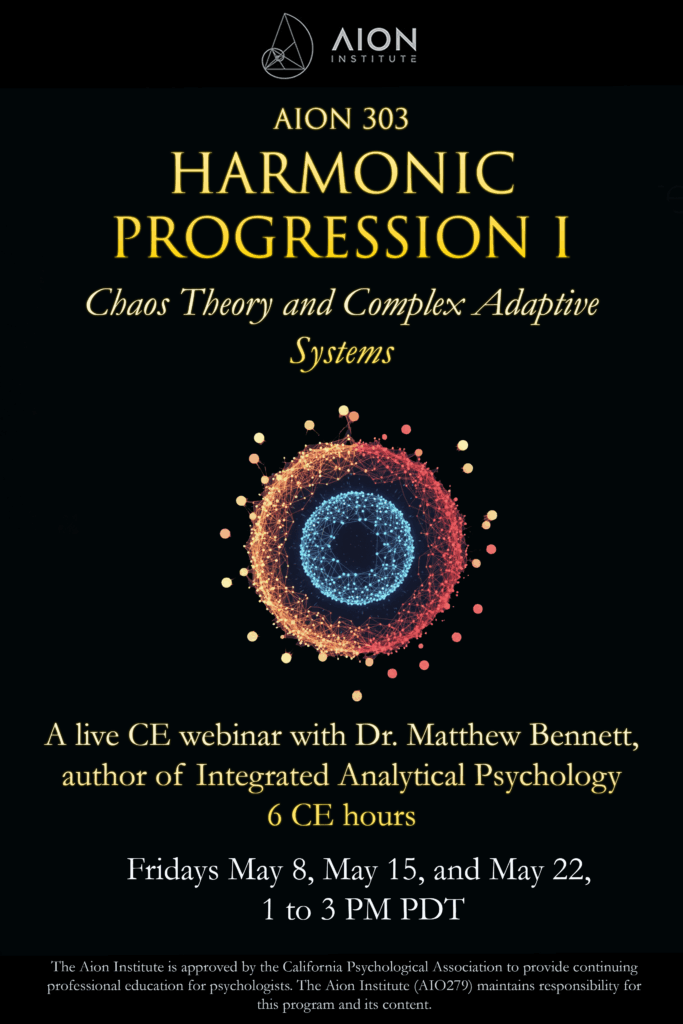
Drawing from Matthew Bennett’s Integrative Analytical model, this course will explore how principles of complexity and chaos theory offer a powerful alternative framework for understanding mental representation and consciousness, moving beyond traditional psychoanalytic and cognitive-behavioral paradigms while incorporating Jungian and post-Jungian sensibilities. Beginning with the notion that mental complexity arises from a breakdown of primordial symmetry, this conversation traces how the human mind responds to these disruptions by creating increasingly complex internal models to assess and shape reality. This perspective draws heavily from the concept of deterministic chaos, where systems governed by clear initial conditions can produce wildly unpredictable outcomes through nonlinear interactions between attractors (forces that promote coherence) and dissipators (forces that introduce change and breakdown), the concept of Complex Adaptive Systems (CAS), the philosophical position of Emergentism, and the Bayesian Brain Hypothesis, which frames the brain as a prediction and hypothesis-testing machine, constantly updating its internal models to minimize uncertainty and “free energy.”
Curricular Notes
Meta-theoretical reorientation
AION 303 inaugurates the Harmonic Progression sequence, marking a decisive shift from depth-psychological content (drives, archetypes, relations) to formal principles of organization. By introducing chaos theory, complex adaptive systems, and emergentist models of mind, this course provides a meta-theoretical scaffold that reframes psychopathology, development, and therapeutic change as nonlinear processes of adaptive reorganization, preparing participants for subsequent Harmonic courses focused on symbolic, relational, and ethical integration
Open Evaluation
The Aion Institute is approved by the California Psychological Association to provide continuing professional education for psychologists. The Aion Institute (AIO279) maintains responsibility for this program and its content.