
AION 201 Course Evaluation
Course Description
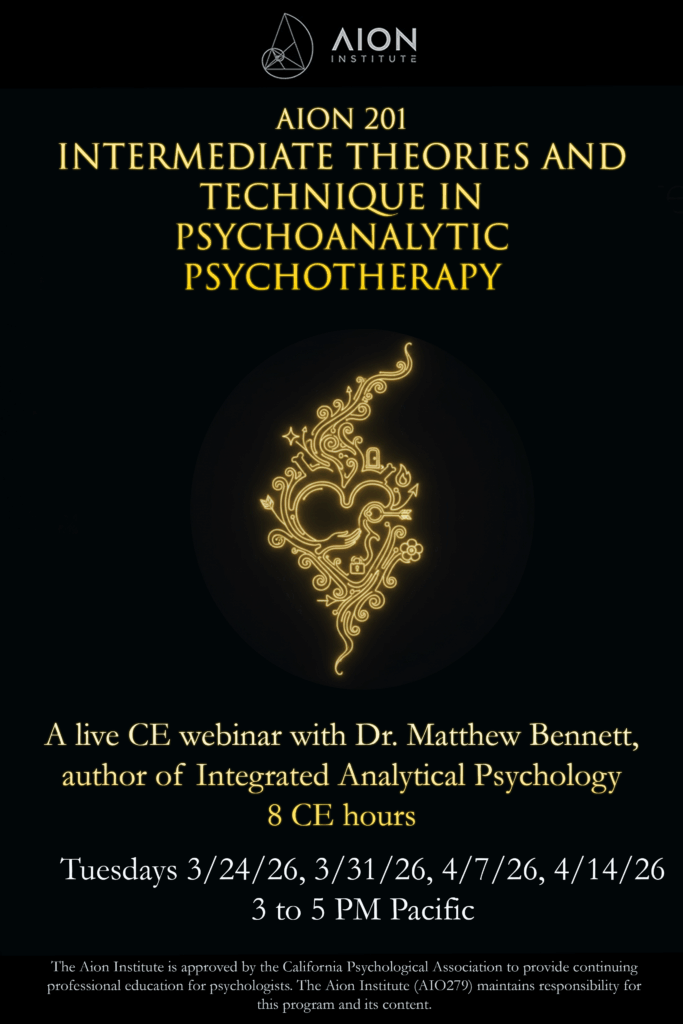
This course builds upon the psychoanalytic perspectives addressed in 101, and elaborates the transition from Object Relations to Self Psychology, and the development of relational psychoanalysis. Specific topics will include psychoanalytic models of self, the developmental scaffolding of anxiety states and their relationship to character structure, and the relationship between object relations and attachment. This course will include readings by Guntrip, Kohut, Ogden, Bion, and Grotstein.
Curricular Notes
Developmental refinement and relational deepening
AION 201 advances participants beyond foundational psychoanalytic structures into the transitional space between classical object relations and contemporary relational thinking. By tracing the evolution from internal object configurations to models of self-cohesion and intersubjectivity, the course refines clinicians’ understanding of how anxiety, attachment, and character structure co-emerge across development. This course deepens developmental sensitivity, enabling clinicians to perceive anxiety states, self-fragmentation, and relational need as scaffolded phenomena rather than isolated symptoms.