
AION 101 Course Evaluation Page
Course Description
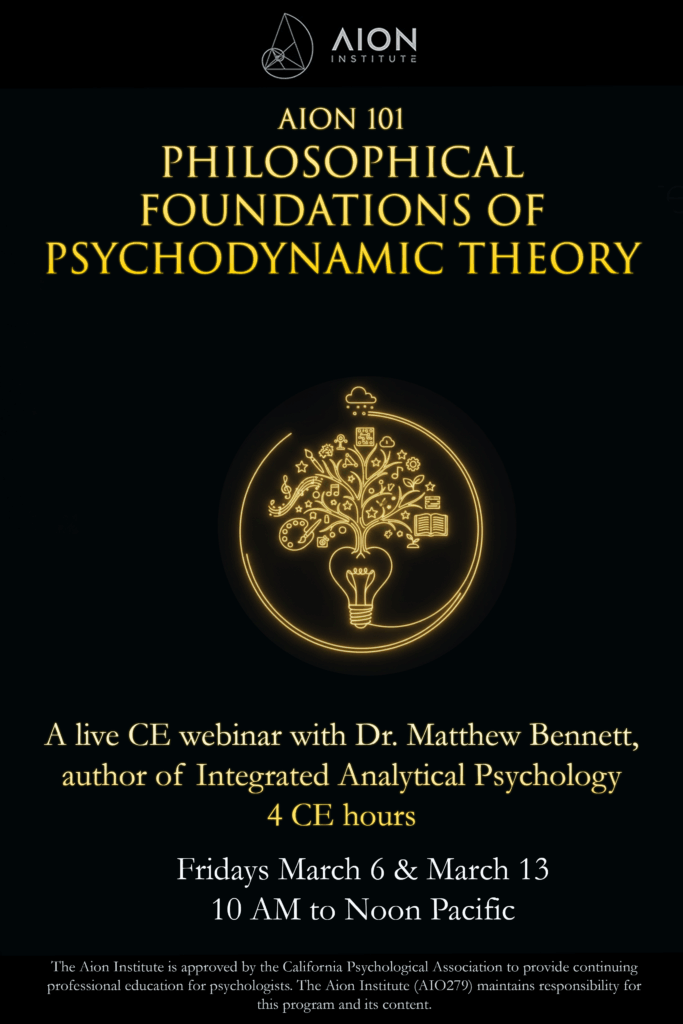
This class includes two two-hour sessions incorporating an overview of some of the more important philosophical, cultural, and scientific contexts leading the development of psychodynamic psychology. Content will include a review of the following philosophical and cultural foundations: ancient systems of spirituality, classical Greek philosophical models such as stoicism, skepticism, and hedonism, as well as neo-platonism, Gnosticism, empiricism, humanism, phenomenology, critical theory, and Zen Buddhism.Curricular Notes
Ontological and epistemological grounding
AION 101 establishes the philosophical soil from which psychodynamic theory grows. Rather than treating psychotherapy as a technical discipline detached from its intellectual roots, this course makes explicit the metaphysical, ethical, and cultural assumptions embedded in all clinical work. By surveying traditions ranging from Greek philosophy and empiricism to phenomenology, critical theory, and Zen Buddhism, the course destabilizes premature theoretical certainty and cultivates reflective awareness of worldview. Developmentally, this course moves participants from unexamined clinical inheritance to self-aware theoretical orientation. It prepares clinicians to recognize that every intervention implies a philosophy of mind, suffering, and change.